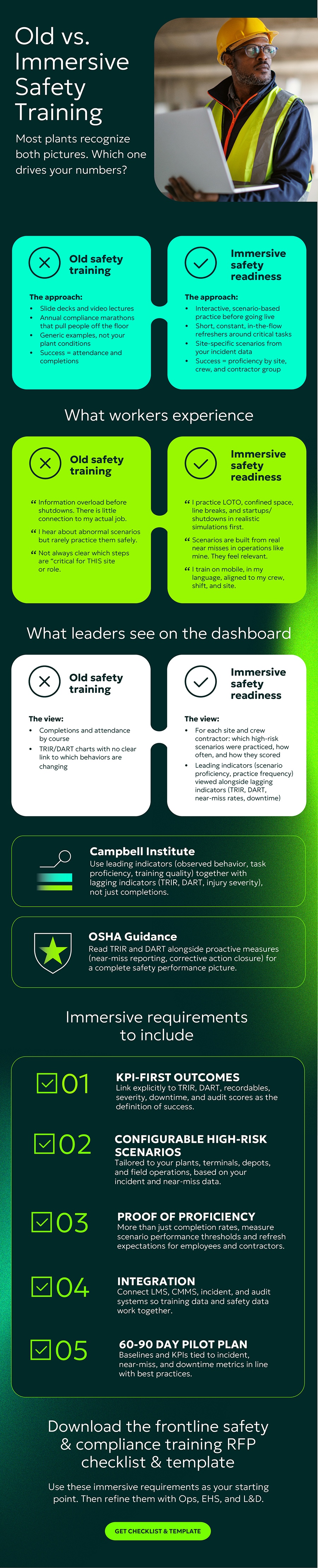
Many organizations can show near-perfect completion on required safety courses and still see the same near misses, recordables, and serious incidents in the same units and tasks.
On the floor, the gap between "trained" and truly ready shows up in the moments that matter—a rushed lockout, a compressed shutdown window, a contractor in a high-risk area, or a startup after maintenance.
TRIR and DART make it obvious: when those numbers stay flat or creep up, training is not acting as a real control, no matter how many modules people have completed.
Studies consistently find that slide decks and lectures deliver weaker gains in hazard recognition and safe performance than interactive, scenario-based, and simulation-driven approaches, where workers rehearse realistic scenarios like LOTO, confined space, or abnormal startups before they face them live.
The teams getting ahead of this are shifting to an immersive readiness model—designing training around highest-risk tasks and abnormal situations, building scenarios from actual near-miss data, and expecting partners to show proficiency by site, crew, and contractor group.