Every major transformation has a human capital challenge. A new operating model is approved, a system goes live, an initiative moves from pilot to enterprise deployment, a policy changes, a service model evolves, or a new product reaches the market.
Then comes the hard part: helping people do their jobs differently and do them well. That is where many transformations lose momentum. The strategy may be clear in the executive meeting and the implementation plan sound, but across the organization, people are still working from yesterday’s assumptions, outdated guidance, informal workarounds, and inconsistent interpretations.
For COOs, that is an execution problem. For CHROs, it is a workforce capability problem. For both, it is a business readiness problem.
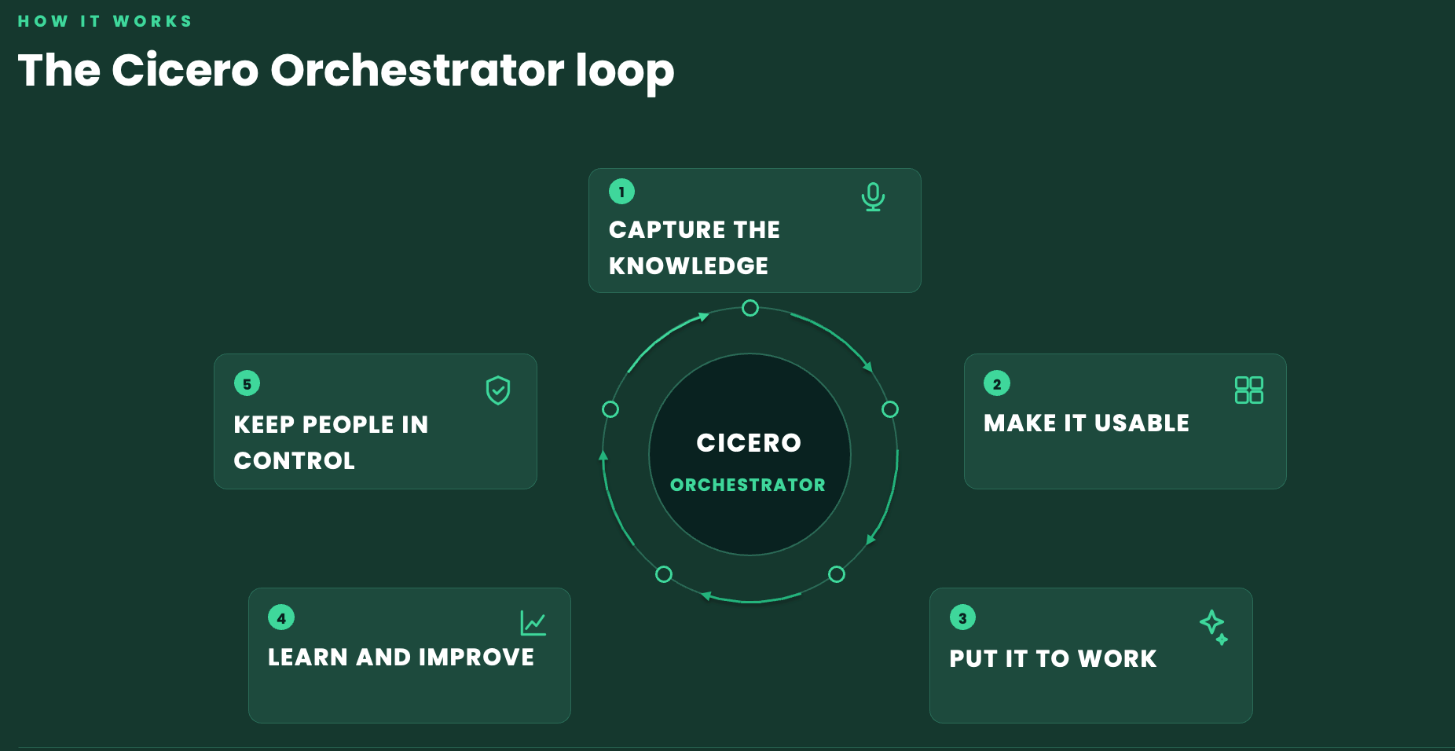
Within the Cicero platform, Cicero Orchestrator is the governed AI intelligence layer that sits between expert knowledge and workforce execution. It captures critical know-how from experts and approved business sources, structures it into reusable and traceable records of knowledge, and keeps workforce-facing outputs current as the business changes. In practical terms, it helps organizations close the distance between deciding on change and seeing that change performed consistently in the work.
Transformation has a human adoption problem
Every organization wants transformation to move faster. The obstacle is that business knowledge changes faster than many organizations can translate it into practical capability.
A policy owner updates a document. A product leader explains the new offer. An operations team changes a process. Learning teams build training, managers brief their teams, support teams revise job aids, and regional teams adapt the message locally. The work is necessary, but often fragmented. The cost of that fragmentation is measurable. Panopto and YouGov found employees lose 5.3 hours a week either waiting on information from colleagues or recreating knowledge that already exists, roughly $47 million a year in lost productivity for an enterprise of 17,700 people.
By the time employees receive the new guidance, different teams may be working from different versions of the truth. Experienced employees explain the same nuance repeatedly. New employees learn through a mix of formal content, manager interpretation, and trial and error. Leaders can see who completed a course, but not always who is ready to make the right decision in a live situation.
That is not a content problem; it is a readiness problem. Workforce readiness means employees and managers can understand a change, practice the decisions it requires, and apply it consistently in real operating conditions. When change is continuous, readiness must be continuous too.
The bottleneck is expert judgment
The knowledge that drives quality, safety, compliance, customer experience, and operational performance lives in the judgment of people who know what to do when the process is unclear, the situation is unusual, or the exception matters. They know the warning signs to catch early, the trade-offs to make, and the errors that less experienced employees miss.
That expertise is invaluable, but vulnerable:
Tacit knowledge vulnerability: Panopto and YouGov found that 42% of institutional knowledge is unique to a single employee. When that person is out, teammates cannot do 42% of the job.
Operational drift: Experts become bottlenecks, teams invent local workarounds, and training content quietly drifts away from actual execution.
Impending brain drain: APQC found organizations expect 51% of their workforce to retire or leave within five years, while 92% still do not consistently capture what those people know.
The answer is not to ask experts to produce more documents, but to capture the judgment behind the work, validate it, and make it usable wherever the workforce needs it.
What Cicero Orchestrator does
Cicero Orchestrator creates a governed path from expert knowledge to workforce execution across four core moves:
Capture critical expertise: Bring together decisions, examples, edge cases, watchouts, and operating context absent from formal documentation, turning them into governed, reusable knowledge objects instead of fragile tribal memory.
Govern the source of truth: Organize expertise alongside approved SOPs, policy manuals, playbooks, videos, and legacy learning so processes, systems, and people stay aligned.
Activate capability at the right level: Generate role-relevant learning, simulations, roleplays, coaching, assessments, job aids, and 3D diagrams agentically and on demand, tailored to each learner's level and kept current as the business changes.
Orchestrate global rollout: Launch governed content simultaneously in over 30 languages from a single source, cutting translation and update costs while holding one consistent narrative across every market.
Cicero Orchestrator is not a faster way to make training content; it is a way to turn approved operational knowledge into a repeatable workforce readiness engine.
From one change to capability at scale
Consider a global manufacturer transitioning field operations to an AI-assisted service delivery framework. Customer Service needs escalation rules, managers need coaching tools, quality teams need revised scorecards, and Compliance needs confidence, all without each region rewriting the operating model.
A traditional rollout creates a long chain of handoffs: expert interviews, content briefs, separate production, review cycles, manager materials, localization, and post-launch updates. Each step creates delay, drift, or inconsistency. Cicero Orchestrator and CGS Immersive turn that chain into one governed workflow:
1. Capture the expertise: Policy owners, operations leaders, product experts, CX strategists, and risk teams contribute operational decisions and context.
2. Validate and govern: Connect captured expertise with approved source materials across review, compliance, localization, and stakeholder workflows.
3. Create role-based capability: Inform learning modules, microlearning, scenario practice, simulations, roleplays, coaching tools, assessments, process maps, and performance support.
4. Deliver consistently: Deliver single-source-of-truth experiences tailored to role, context, and language across 30+ languages.
5. Measure execution: Track participation, assessment, practice, coaching, and performance signals to show where teams are ready or where adoption needs work.
What CHROs gain from Cicero Orchestrator
CHROs are increasingly responsible for building capability at the pace of business change. Cicero Orchestrator makes employee development responsive to operating realities:
Continuous upskilling: Employers expect 39% of core skills to change by 2030, with 63% citing skills gaps as their biggest transformation barrier. Cicero converts changing business knowledge into relevant learning as needs evolve.
Visibility into capability: Average scrap learning — training delivered but never applied — runs at 60% (Training Industry/Brinkerhoff) and fewer than 16% of organizations can effectively track behavior change or business impact, with 43% measuring no business impact at all (Brandon Hall). Cicero uses readiness signals to highlight where employees need reinforcement.
Strengthened onboarding & mobility: Structured onboarding yields 82% better retention and 70% higher productivity, yet median time-to-productivity remains 65 days. Reskilling is 2.5x cheaper than hiring. Cicero makes role-relevant expertise available on entry rather than after ramp.
Institutional knowledge retention: Turnover costs employers $2.9 trillion globally, at $45,236 per departure. The compounding factor is that 42% of what leaves was never written down and 92% of employers have no consistent way to capture it before the exit interview. With over 11,200 Americans turning 65 every day through 2027, the exposure is only widening. Cicero preserves critical operational judgment before employees depart.
Equipped managers: 70% of team engagement variance traces to managers (Gallup), yet transfer research shows only 34% of trained employees still apply material after a year. Cicero provides managers with coaching tools, practice opportunities, and shared expectations.
Why governance of AI-powered upskilling matters
AI makes it possible to create and update workforce experiences quickly, but it does not remove the need for judgment, review, accountability, or trust. When scaling AI-enabled learning, governance becomes critical. Employees need confidence, managers need approved guidance, compliance needs traceability, and experts need a simple review process.
Cicero Orchestrator provides governed source material, role-based controls, review workflows, traceability, and human oversight. The goal is not automation without accountability but scaling capability without scaling inconsistency. A faster content engine produces more assets; a governed workforce-readiness platform ensures reliable execution.
The knowledge-to-execution lifecycle
Knowledge capture and workforce enablement are closely connected, but distinct:
Cicero Interview: Preserves the judgment of experienced employees and subject-matter experts.
Cicero Orchestrator: Puts that knowledge to work—turning it into governed learning, practice, coaching, performance support, and readiness measurement.
Start deploying AI to workforce readiness where change matters most
The strongest first use case is one transformation where uneven adoption creates meaningful cost, delay, risk, or customer impact, such as a new operating process, policy update, product rollout, system implementation, AI deployment, or service model redesign.
Bring the business challenge, the experts, and the approved source material. Cicero Orchestrator converts the knowledge behind the change into governed learning, practice, and support.
Book a workforce readiness strategy session.
FAQs
What is continuous workforce readiness?
Continuous workforce readiness is an organization's ability to translate changing operational knowledge into consistent employee execution without delay or version drift. Unlike periodic training, it treats capability as an always-current state rather than an event: when a policy, process, or product changes, the guidance, practice, and performance support change with it.
The distinction matters because business knowledge now changes faster than most organizations can convert it into capability. Employers expect 39% of workers' core skills to change by 2030, and 63% already name skills gaps as their single biggest barrier to business transformation — ahead of culture, regulation, and capital. Readiness has three observable components: employees understand the change, they have practiced the decisions it requires, and they apply it consistently under real operating conditions. A completion report confirms none of those three.
How is knowledge capture different from documentation?
Documentation records what the process is. Knowledge capture records the judgment behind it — the decisions, edge cases, trade-offs, early warning signs, and exceptions that experienced people apply when the documented process doesn't fit the situation in front of them.
The gap between the two is the reason expertise stays fragile even in well-documented organizations. Panopto and YouGov found that 42% of institutional knowledge is unique to a single employee and shared with no colleague, meaning teammates cannot perform 42% of that job when the person is unavailable. That knowledge is missing because manuals capture steps, not judgment. Asking experts to produce more documents does not close the gap: capturing, validating, and structuring their reasoning does.
The exposure is widening. APQC's 2025 study of 1,000 organizations found firms expect 51% of their workforce to retire or leave within five years, while 92% still do not consistently capture what those people know before they go.
What does "governed AI" mean in a learning context?
Governed AI means every AI-generated learning asset is traceable to approved source material, reviewed by accountable humans, and controlled by role-based permissions. The AI accelerates production; it does not decide what is true. Governance is what separates a faster content generator from a system a compliance team will sign off on.
In practice, governed AI in learning requires four things: a validated source of truth (approved SOPs, policy manuals, playbooks, captured expert knowledge), review and approval workflows before publication, traceability from any output back to its source, and human oversight at the points where judgment matters.
Without governance, speed compounds risk rather than capability. When materials drift from approved knowledge, the exposure becomes regulatory as well as operational: in OSHA's FY2025 top ten most-cited standards, Hazard Communication ranked second with 2,546 citations and Fall Protection – Training Requirements ranked sixth with 1,907 — training and documentation failures rather than hazard-identification failures. The goal is not automation without accountability. It is scaling capability without scaling inconsistency.
How do you measure workforce readiness beyond completion rates?
Readiness is measured through practice, application, and outcome signals rather than seat time: assessment performance under realistic conditions, scenario and simulation results, coaching observations, on-the-job application, and movement in the operational metric the change was meant to improve.
Completion rates persist because they are easy, not because they are informative. A 98% completion rate tells you 98% of seats clicked Next. The measurement gap is well documented: fewer than 16% of organizations can effectively track knowledge transfer, behavior change, and business impact, and 43% conduct no business-impact measurement at all. The consequence is that average scrap learning, meaning training delivered but never applied, runs at roughly 60% across five published studies.
Transfer research shows why point-in-time measurement misleads: 62% of employees apply new material immediately after training, 44% at six months, and only 34% a year later. Any readiness measure taken once, at completion, captures the best moment on the curve and none of the decay.
A practical readiness stack looks like this:
Participation — who engaged, at what depth
Assessment — can they make the right call in a constructed situation
Practice — are they rehearsing the decisions, and improving across attempts
Coaching — what are managers observing in live work
Business signal — is the operational metric the change targeted moving
What is the difference between Cicero Interview and Cicero Orchestrator?
Cicero Interview is the structured conversation engine; Cicero Orchestrator is the governed activation layer. Interview runs rubric-based, resume-aware interviews that measure capability at hire and capture expert judgment at exit, producing an auditable evidence trail rather than a transcript.
Orchestrator solves the activation problem: how do you take that validated knowledge, combine it with approved SOPs, policy manuals, and playbooks, and turn it into role-relevant capability for thousands of people in over 30 languages, then keep it current as the business changes.
The connective tissue is structure. Interview tags captured knowledge by role, task, context, risk level, insight type, and currency, which is precisely what makes it usable downstream rather than collapsing into long videos and unsearchable transcripts. One engine measures and captures capability; the other governs, personalizes and deploys it. Together they close the path from expert judgment to consistent workforce execution.