A train service is suddenly disrupted during the evening commute. Apps and screens show delays, but they keep changing and never tell passengers which line to take next or how long it will take to get home. Platforms fill, and passengers crowd the nearest staff member for answers.
That employee has completed the disruption handling and communication training, passed the quiz, and even scored well in an AI roleplay simulator. On related dashboards, they look “ready,” with scenarios completed, scores above the threshold, and feedback marked as green. But under pressure, they repeat a generic announcement, never answer the real questions (“Which line? How long?”), and turn a manageable delay into anger, complaints, and social media videos.
Multiply that by every transit system, service desk, clinic, and contact center across large organizations, and the gap becomes global. The data says people are trained. Outcomes say they are not.
First-generation AI roleplay tools stop at shallow analytics: who completed which scenario and what they scored. Cicero starts with lifelike, unscripted, emotion and friction-rich practice, then turns those interactions into deeper analytics that reveal how people behave under pressure, how those behaviors change over time, and why key conversations land or fail for each employee and across your entire organization.
The hidden cost of just counting completions
Most organizations can recite their learning metrics by heart: enrollments, completions, time in course, satisfaction scores. Those numbers are easy to track and easy to present, but they are often disconnected from what happens when the next disruption, safety decision, or renewal conversation gets tense.
The costs are real. McKinsey’s analyses of skill gaps estimate that productivity in affected roles can drop by around 20 percent, as work slows, errors increase, and teams spend more time fixing issues than moving forward. Ineffective or mis-targeted training can waste millions more each year in large enterprises when development, delivery, and time away from the job are considered. And according to Forbes, 95% of AI initiatives fail to realize their expected value because behavior and process change never keep pace with the technology.
Course completions tell you who showed up, but seldom who can perform when pressure, emotion, ambiguity, and risk enter the conversation.
Three critical moments your current AI workforce training analytics can’t see
The escalation that did not have to happen
A customer calls about a recurring fee. The agent uses the opening script but misses the moment to acknowledge the customer’s frustration. They explain the policy three times instead of asking one good question. And when they offer a partial credit, it feels dismissive rather than helpful. The customer leaves more upset than when they started, and the business now has a supervisor escalation, a complaint to manage, and a customer more likely to churn.
Analytics in baseline AI tools show a completed ‘difficult conversations’ module and maybe a slightly elevated handle time. Cicero shows a very different picture:
How often the agent interrupts versus listens in lifelike roleplays.
Whether they use the empathy and discovery behaviors they practiced in Cicero scenarios.
How their pattern compares to peers in Cicero who see fewer escalations.
Why the conversation did or did not land, using Cicero Replay to break down the moments where trust and commitment rose or dipped.
Now the organization sees real performance risk and a coaching opportunity, not just a completed course.
The safety step they keep skipping
A technician works through a critical safety procedure they “learned” in traditional training supported by baseline AI roleplay tools. Under pressure, they rush and skip a verification step. Most days, nothing bad happens, but occasionally something does, and the post-incident story you hear is familiar. They knew the procedure, but they did not follow it in the moment.
Standard analytics tools show 98% completion on mandatory safety training and a green report that looks good in an audit. Cicero shows where risk is hiding.
Cicero shows:
How often each step in the procedure is followed correctly in realistic Cicero scenarios.
Which specific steps are most frequently missed when time pressure or distractions are simulated.
How error rates change over time by site, shift, role, or tenure as people practice in Cicero.
Why certain attempts feel “good enough” to the learner but still carry risk, using Cicero Replay to highlight the exact moments where attention or judgment slipped.
That is the difference between reporting coverage and exposing the leading indicators of an incident.
The deal that died in slow motion
A rep walks into a renewal or expansion conversation with strong product knowledge and a polished deck. In the call, they ask generic discovery questions, miss subtle buying signals, and concede too early on price. The pipeline looks healthy until this deal, and others like it, quietly stall or shrink.
Pre-meeting, standard AI analytics tools showed sales onboarding had been completed with a good certification score. Cicero would have shown why the deal never had a chance:
How well the rep handles specific objections in Cicero roleplays, including the quality and timing of their responses.
Whether they ask the right follow-up questions at the right moments in simulated calls, not just whether they cover a script.
How their pattern compares to top performers in Cicero who consistently advance and close similar deals.
Why the conversation did or did not land, using Cicero Replay to reveal the moments where urgency, trust, or value either strengthened or broke down.
With Cicero, analytics explain the real story behind the pipeline’s growth or retraction, rather than just reporting blunt data on how a rep was prepared.
Why workforce readiness analytics from Cicero are indispensable
In all these moments, the problem is not a lack of data; it is a lack of the right data with sufficient nuance. Cicero turns every practice session into evidence of how people behave under pressure, how those behaviors change over time, and where risk or opportunity is building.
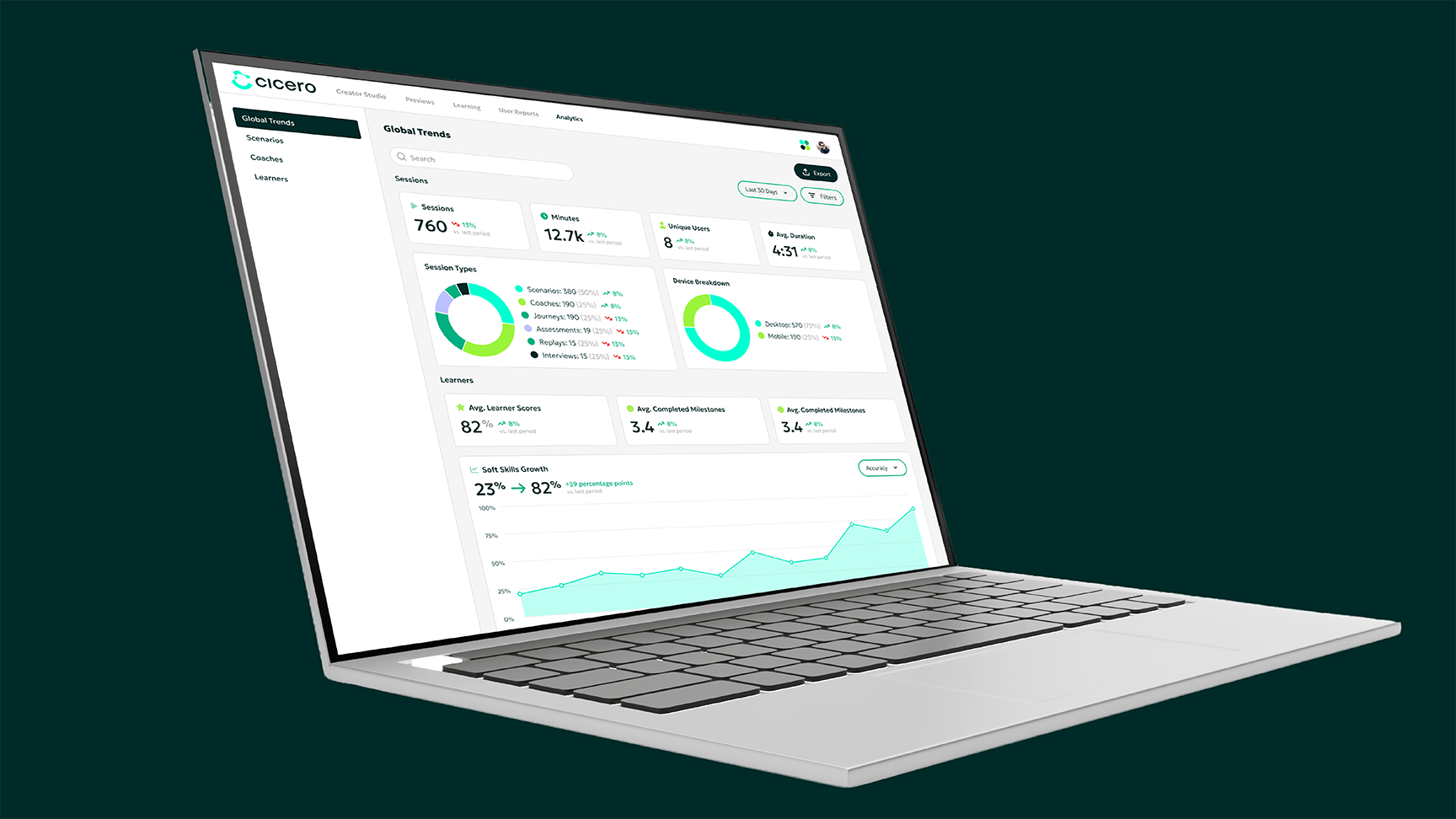
Our Global Trends reports show how practice moves over time across Cicero, where it is spiking or stalling by organization, role, or use case, and which parts of the workforce are engaging with essential scenarios and skills. Leaders can see at a glance where readiness is building and where it is falling behind. Soft Skills Growth tracks start scores, current scores, and improvement scores for the specific skills that drive CX, safety, and sales outcomes. This turns vague “soft skills” into measurable trends.
From the same workflow, teams can move through:
Sub Organizations: how regions or business units are performing,
Scenarios and Coaches: which practice experiences and coaches are moving the needle,
Tests: how formal assessments are trending, and
Learners: individual histories and career paths; personal learning records, role history, and future career success pathing.
They can then drill down into evaluation details and session-level evidence using consistent filters, controls, exports, and navigation patterns across pages.
From there, Cicero Journeys uses real performance data to build truly personalized paths, tethering multiple real-world scenarios so people can see how each choice shapes what happens next and practice navigating complexity over time, not just in a single interaction. Instead of getting one round of feedback and moving on, learners progress from high-risk behaviors to the patterns your best performers already show in Cicero, with each session informed by their scenario history and mapped to the competencies that drive your business.
That consistency turns every interview, roleplay, coaching conversation, and XR-powered “call your coach” moment into a single skills signal leaders can tie to revenue, risk, and churn, while still tracking readiness and time-to-competence across roles.
Why missing granular analytics on workforce readiness is so costly
Most AI training tools stop at “good conversations.” They generate polished answers, generic coaching tips, and completion stats—but they rarely prove that behavior changed or that revenue, risk, or churn moved in the right direction.
Cicero is built as a closed-loop system: every interview, roleplay, coaching session, and XR scenario feeds a single skills signal that you can tie directly to time to competence, quality of hire, safety incidents, and deal or renewal outcomes. Ignoring what really happens in conversations is expensive. Skill gaps show up as reduced productivity, higher error rates, lost revenue, and extra hiring costs.
Most AI dashboards still tell this story in the flattest possible way. Completions are high, satisfaction is decent, and yet customers escalate, incidents occur, and deals decay quietly.
Cicero’s analytics make the underlying behaviors visible. It shows who interrupts customers and who listens, who follows the prescribed critical steps and who skips them, who successfully handles objections and who folds, and how those patterns change over time. Live, real-time feedback and prompts then help every team member master these moments and reduce costly losses for the business.
See the signals that move the needle in your business. Explore Cicero.