Advanced manufacturing is moving faster than ever. On any given factory floor, teams are integrating automated systems, connected machinery, collaborative robotics, and AI tools at an unprecedented pace.
Yet while tech stacks upgrade in real time, frontline capability is still running on yesterday’s training models.
This creates the Workforce Adaptation Gap: the widening delay between when shop-floor technology changes and when frontline workers are trained to use it safely, confidently, and efficiently.
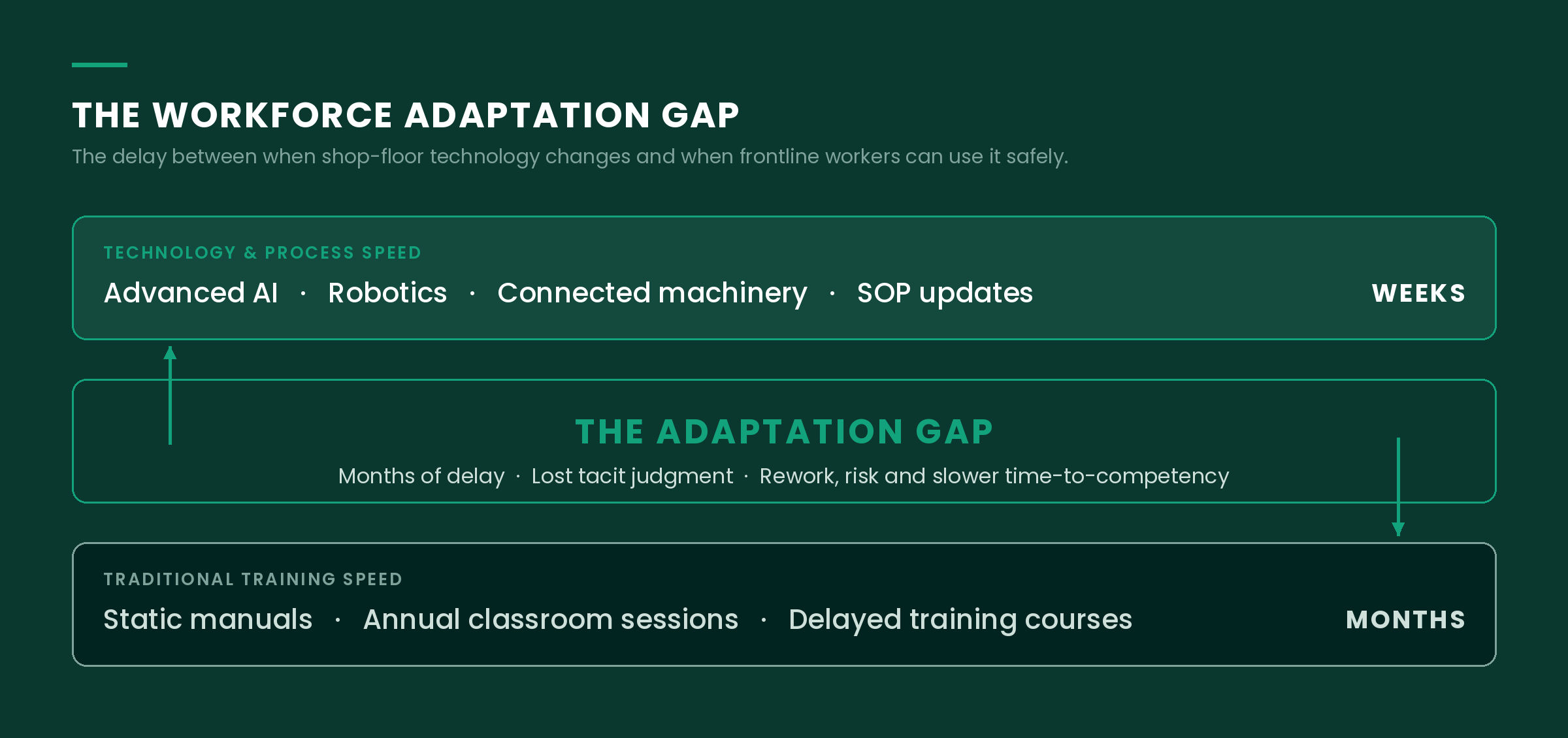
Figure 1 — The Workforce Adaptation Gap: technology moves in weeks, traditional training moves in months.
The macro reality: Silver Tsunami meets rapid tech shifts
The industrial sector is navigating a perfect storm where demographic shifts meet technological acceleration:
The Silver Tsunami. Over 25% of the manufacturing workforce is over age 55. Joint research by Deloitte and The Manufacturing Institute projects that up to 1.9 million manufacturing jobs could go unfilled by 2033 as veteran technicians retire faster than traditional pipelines can replace them.
The high cost of lost tacit knowledge. Industry research from Dovient, Workcell, and iFactory suggests that around 70% of critical operational knowledge in manufacturing is undocumented “tribal knowledge” — living in the heads of experienced workers rather than in any system. Large plants routinely lose tens of millions of dollars per year through extended onboarding, repeat quality errors, and duplicated troubleshooting when those workers transition out.
The Ebbinghaus Forgetting Curve. Association for Talent Development (ATD) findings show that learners in passive, classroom-style environments forget up to 70% of new information within 24 hours if it isn’t reinforced quickly through active practice and point-of-work retrieval.
Rapid skill decay. According to the World Economic Forum, 40% of core skills required in advanced manufacturing will change within five years — rendering annual or bi-annual training cycles obsolete almost as soon as they launch.
The message is simple: you can’t run modern factories on 2006 training assumptions.
Why legacy training models fail the factory floor
For decades, industrial workforce development followed a predictable path: draft a standard operating procedure (SOP), build a manual, enroll workers in a yearly training course, tick a completion box, and hope the skills transfer to production.
In modern smart manufacturing, that model breaks down at three points:
Static content vs. dynamic work. Updating formal training content often takes months. By the time a new course reaches the floor, equipment configurations, software interfaces, or safety watch-outs have already changed.
Loss of tacit judgment. The most valuable insights: troubleshooting shortcuts, micro-adjustments, decision rules, early failure warnings, live in the heads of senior workers. SOPs rarely capture that judgment, and “ask Joe” is not a scalable system.
Completion vs. demonstrated competency. Traditional approaches measure course completion, not first-time-right operational capability. Knowing the theory behind a machine tool doesn’t mean a technician can safely perform a complex setup under real shift conditions.
The result is a growing gap between what your systems say workers can do and what actually happens when the line is under pressure.
Closing the loop: frontline capability at technology speed
To eliminate the adaptation gap, organizations need to move from periodic course development to a continuous adaptation loop. Learning can’t sit outside the operation; it has to run on the same clock as equipment, software, and quality metrics.
That is the role of Cicero Orchestrator, the governed AI engine that captures expert judgment at the source, turns it into deliberate practice, and keeps content, coaching, and analytics in lockstep as the work changes.
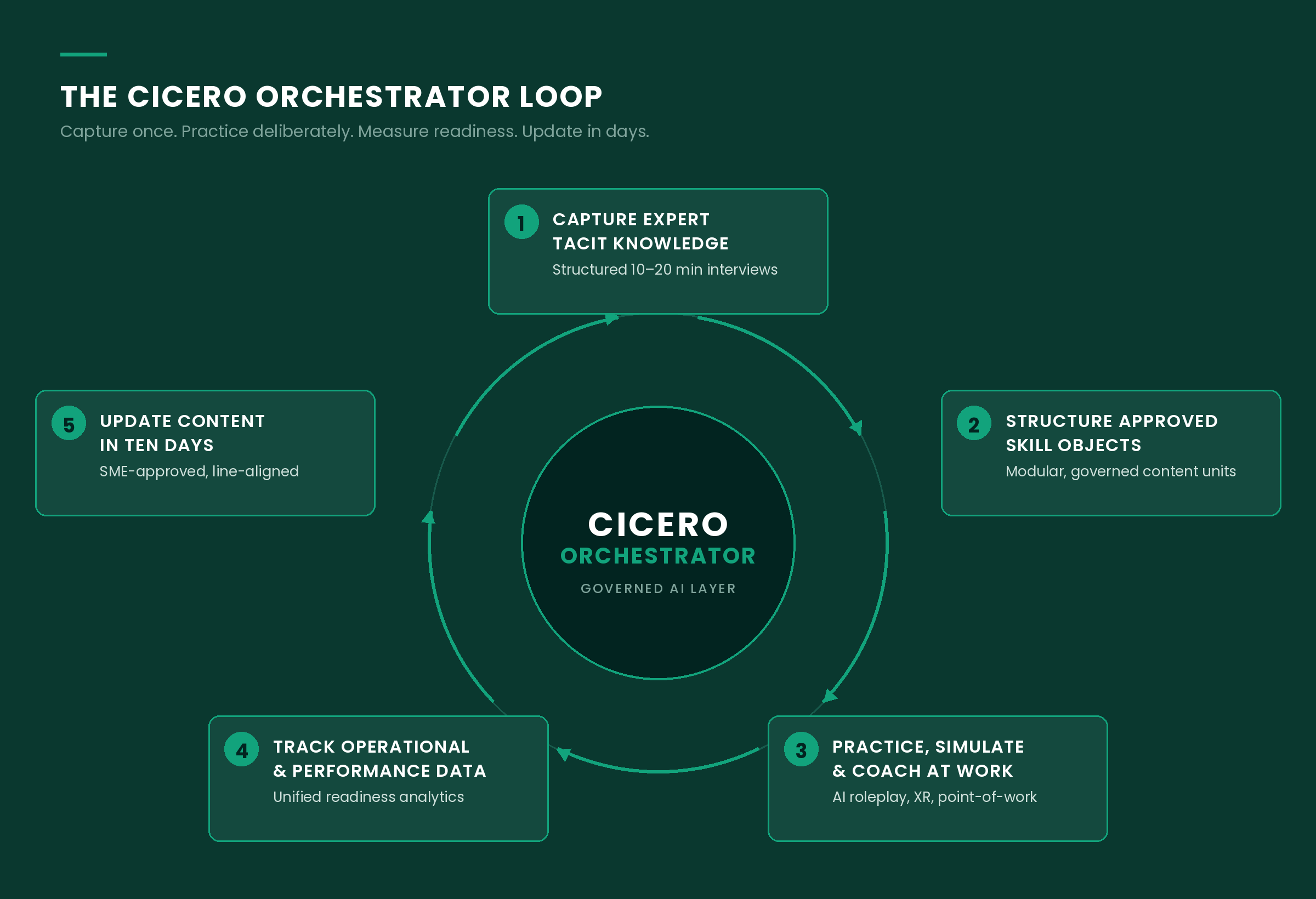
Figure 2 — The Cicero Orchestrator loop: capture, structure, practice, measure, update.
How Cicero Orchestrator changes industrial execution
Instead of asking your best engineers to write long manuals, Cicero Orchestrator turns everyday expertise into a closed‑loop system that lives where the work happens:
Rapid expert capture. Structured 10–20 minute conversations capture critical failure modes, decision trees, and practical watch‑outs before they walk out the door. Live sessions, “see‑what‑I‑see” walk‑throughs, and annotated recordings become reusable knowledge assets rather than one‑off fixes.
Guided, step‑by‑step workflows. Captured expertise is converted into visual, step‑by‑step instructions, digital overlays, and task lists that technicians can follow in real time—whether they’re bringing a new line online, running a complex setup, or performing a high‑stakes repair.
Risk‑free practice and point‑of‑work coaching. Technicians rehearse high‑stakes decisions, quality handoffs, and abnormal‑condition troubleshooting in risk‑free simulated environments. On the floor or in the field, they can pull up recordings, replays, and live remote support that delivers context‑aware refreshers right at the asset, when the decision matters.
Ten‑day priority updates close the loop: operational data, friction points, and recurring “fix” patterns flow back into the Orchestrator engine. Subject-matter experts approve changes, and governed agents generate the right guidance for the moment — foundational onboarding for new technicians, step-by-step task support for the floor, or expert-level troubleshooting practice for experienced teams — in ten business days or less, so guidance and training stay aligned with line changes instead of trailing them by months.
One approved source across every plant and market. When a procedure changes, manufacturers should not have to rebuild it for every region. Cicero Orchestrator can generate, translate, and validate governed outputs from the same source across 29+ languages — keeping local teams aligned to one approved operating standard while reducing translation, update, and version-control overhead across global operations.
Instead of a static course library, you get a living system: capture, guide, practice, coach, measure, update—all governed in one platform.
The business case: modeling your frontline ROI
Continuous adaptation is not just a learning strategy, it is an operational strategy that drives margin, safety, and throughput. Enterprise implementations of Cicero Orchestrator target a 1.5:1 benefit-to-cost ratio or higher through three direct financial levers.
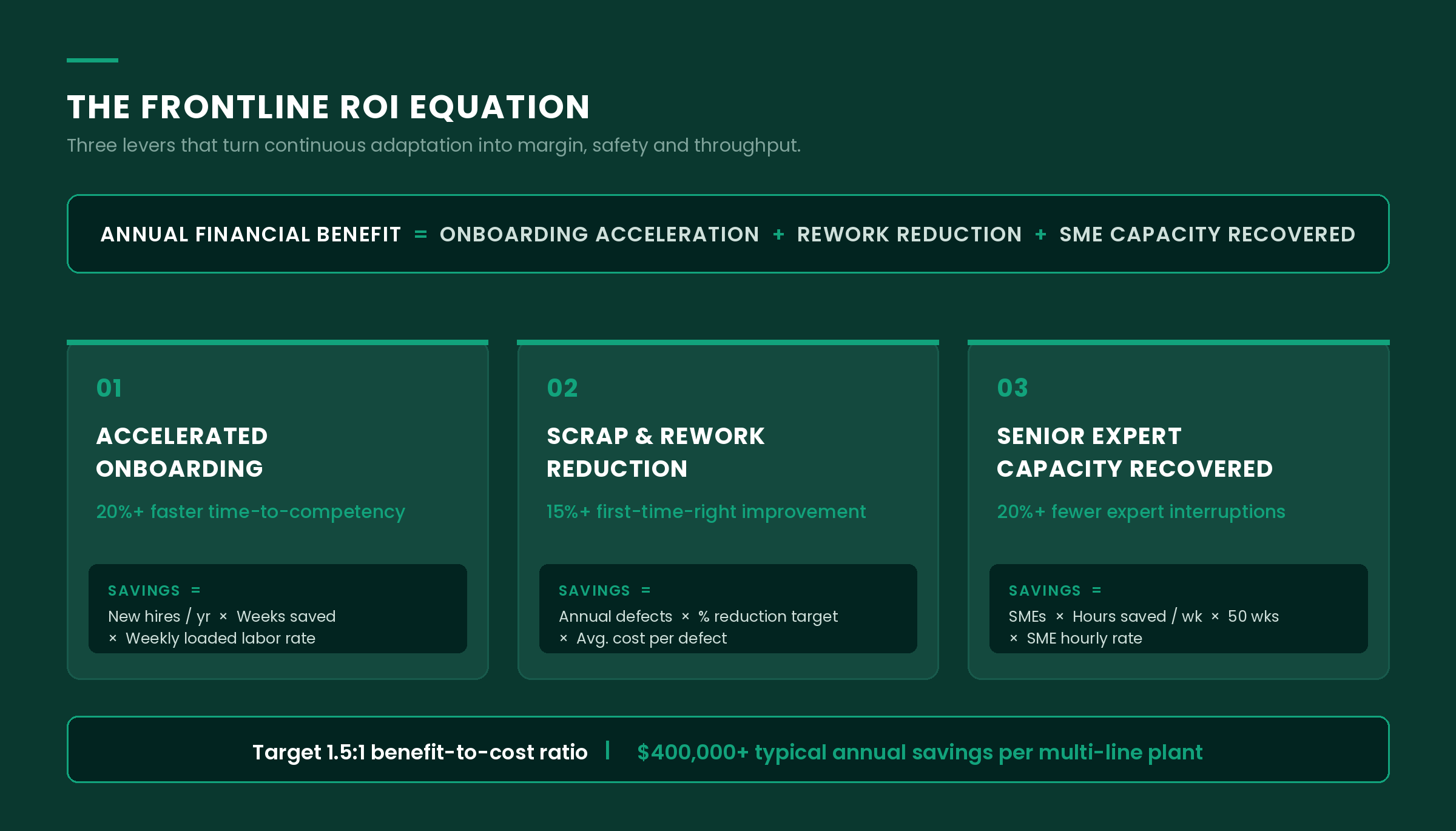
Figure 3 — The frontline ROI equation: onboarding acceleration, rework reduction, and recovered SME capacity.
1. Accelerated onboarding
Cutting median time-to-competency by 20%+ gets new assemblers, machinists, and technicians to full productivity weeks faster.
Savings = (New hires per year) × (Weeks saved) × (Weekly loaded labor rate)
2. Scrap and rework reduction
Achieving a 15%+ improvement in first-time-right quality prevents costly scrap, rework, and downtime incidents.
Savings = (Annual defects) × (% reduction target) × (Average cost per defect)
3. Senior expert capacity recovered
Reducing repeated “tap-on-the-shoulder” interruptions by 20%+ frees high-value master technicians to focus on throughput, maintenance, and complex problem-solving.
Savings = (Number of SMEs) × (Hours saved per week) × 50 weeks × (SME hourly rate)
For a typical multi-line manufacturing plant, combining these levers regularly generates $400,000+ in annual operational savings, quickly returning the initial platform investment.
Moving beyond “course libraries”
A bigger library of static, unused courses won’t solve the manufacturing talent crisis.
Industrial leaders need a resilient, self-updating workforce system that adapts as fast as their equipment and software evolve. By capturing expert judgment before it leaves the floor, turning approved knowledge into deliberate practice, and measuring real-world readiness with governed analytics, manufacturers don’t just keep up with technological change; they compete on it.
Explore Cicero Orchestrator: product overview | CGS Immersive | Cicero platform
Ready to close the Adaptation Gap in your facilities?
Stop letting veteran expertise walk out the exit door. Partner with us to test and validate the closed loop workforce model and calculate your avoided costs with your numbers, not ours.